
By Abby Payne | Nov. 1, 2024
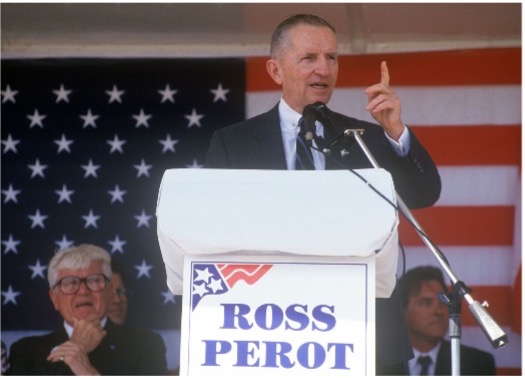
In 1992, Texas businessman and billionaire Ross Perot made his political debut as the independent candidate during the 52nd quadrennial presidential election where he was able to secure almost 19% of the popular vote. Despite not winning, Perot’s significant run seemed to set the stage for future third-party and independent candidates.

As American voters go to the polls for the 2024 presidential election, the hope of voting for a third party seems far from reality — but it is possible.
There has been only one person to ever win the presidency of the United Staes as an independent candidate.

A third-party candidate is a politician who aligns with a political party outside of the two-party system which is currently dominated by Republicans and Democrats. While these candidates are not part of the two main parties, they are still expected to uphold the policies and values that correspond with their party.

An independent candidate is a politician that does not align themselves with any political party. While this entails more freedom for the candidate to express their personal stance on a variety of topics, independents typically do not have the financial or voter support that most party-aligned politicians do.
Political parties are not a new concept in the U.S., in fact, the first parties were the Federalists and the Anti-Federalists who emerged in 1772 over the debate of the ratification of U.S. Constitution. The first and only candidate to ever win presidency as an independent was the very first president, George Washington, in 1789.

However, Washington and Perot are not the only two to try their success as independents. Another notable figure is former Alabama Gov. George Wallace, who won 14% of the popular vote in the 1968 presidential election.

There have also been significant candidates to run under a third party. The most notable figure is former President Theodore Roosevelt, who ran for this third term in office under the Progressive Party in 1912. While Roosevelt did not win that election, he secured 88 electoral votes, 80 more than the Republican candidate, William Taft.

Democracy, Independent and Third-Party Candidates
Despite America’s extensive history of politics and democracy, third-party and independent candidates have found it increasingly difficult to win a presidential campaign because they face financial struggles and the overwhelming dominance of the two-party system; the two factors work hand-in-hand.

“Winner-takes-all systems generally create a situation where voting for a third-party candidate is basically throwing away your vote,” said Auburn political science professor Joseph Aistrup. According to an article posted on LSD.law, a winner-takes-all system “is an election in which the candidate who receives the majority or plurality of votes wins all the seats or representation.”

This system affects independent and third-party candidates because they may win a sizable portion of the popular vote, but it does not guarantee they will win any electoral votes, which is the determining factor in a presidential election.

The difficulty of winning electoral votes also affects a candidate’s ability to raise funds for their campaign, which can determine how much outreach they have among voters. Fewer funds mean less money can be used on media advertisements, campaigning staff, travel expenses and merchandise.

Another major challenge is the lack of media coverage for these candidates and the exclusion from events like national debates. According to Goodparty.org, to participate in a national presidential debate, the candidate must have an average of at least 15% support in the national polls, a 10-point increase from the 5% required in 1992 as a direct result of Perot gaining 19% of the popular vote.

Despite the numerous obstacles these candidates face during election season, American voters believe that they are just as important as candidates reigning from the two-party system.

I conducted an informal online survey among multigenerational voters. They do not want their identities disclosed.

Over 40% said it was not their first time voting in an election, but only one person claimed they voted for a candidate outside of the two-party system.

When survey participants were asked if they believe voting for independent and third-party candidates is beneficial or pointless, multiple participants said they would show support for candidates who were not members of the Republican or Democratic parties.

One participant said, “I think it’s tremendously helpful and important. … If we continue to only elect these far right and far left politicians to lead our country, division will only increase. Third party candidates deserve to be equally considered as the finalists in the race because of their motive. To me, … third party candidates pursue moderate [policies] and can find middle ground between the two extremes this country has had for decades.”

Another added, “It’s beneficial because it allows voters who may not totally side with one party or the other to vote for someone with their same beliefs.”
Republican candidate Donald Trump and Democratic candidate Vice President Kamala Harris are not the only candidates sharing their political platforms across the U.S.

There are also 22 third party and independent candidates running for president. However, each state does not print them on their ballots.

For example, in the state of Alabama, voters can also select one of the following independent and third-party candidates: Green Party candidate Jill Stein is running for president; the Libertarian candidates are Chase Oliver and Mike ter Maat; and Independent Robert Kennedy Jr. and his vice presidential nominee Nicole Shanahan are still listed on the ballot although Kennedy suspended his campaign in August and endorsed Trump.

Auburn political science professor Mitchell Brown said conducting research is one of the most important ways voters can stay aware of their options for the presidential campaign.

“It all requires doing work, and that work involves learning in advance who’s on the ballot and looking up information about those people, what they stand for, what policies they support and most people are willing to put in that kind of effort,” Brown said.

Putting in the effort to research a candidate’s position on policies and their personal beliefs, regardless of their party affiliation, can enable voters to make a choice at the poll that better aligns with their values.
Simplified Summary
In 1992, Texas businessman Ross Perot ran for president as an independent. Even though he didn’t win, he earned almost 19% of the popular vote. His strong performance made people think more seriously about third-party and independent candidates. As Americans prepare to vote in 2024, third-party candidates still have a hard time getting elected. Only one independent, George Washington, has ever been elected president. A third-party candidate is someone who belongs to a smaller political party, not the Republicans or Democrats. An independent candidate doesn’t belong to any political party. Independents have more freedom to share their own views, but they usually struggle to raise money and gain support. Third parties have been part of U.S. history for a long time, starting with the Federalists and Anti-Federalists in the 1700s. Besides Perot, others like George Wallace (1968) and Theodore Roosevelt (1912) also ran strong campaigns outside the two main parties. Independent and third-party candidates face big challenges. America’s “winner-takes-all” system makes it hard for them to win electoral votes, even if they earn a lot of the popular vote. They also struggle with raising money, getting media coverage, and joining national debates. Debate rules now require candidates to have 15% support in polls, which is much higher than in 1992. Despite these challenges, many voters believe it’s important to support third-party and independent candidates. In a small survey, many participants said they would consider voting for someone outside the two main parties to help bring more balance to politics. In 2024, besides Trump and Harris, there are 22 third-party and independent candidates running. However, not all of them appear on every state’s ballot. For example, in Alabama, voters can choose candidates like Jill Stein (Green Party), Chase Oliver and Mike ter Maat (Libertarian Party), and Robert Kennedy Jr. (Independent, though he suspended his campaign). Experts say it’s important for voters to research all candidates before voting so they can make the best choice for themselves.


